Sun Conure Colors & Mutations: A Complete Guide
Updated October 19, 2026
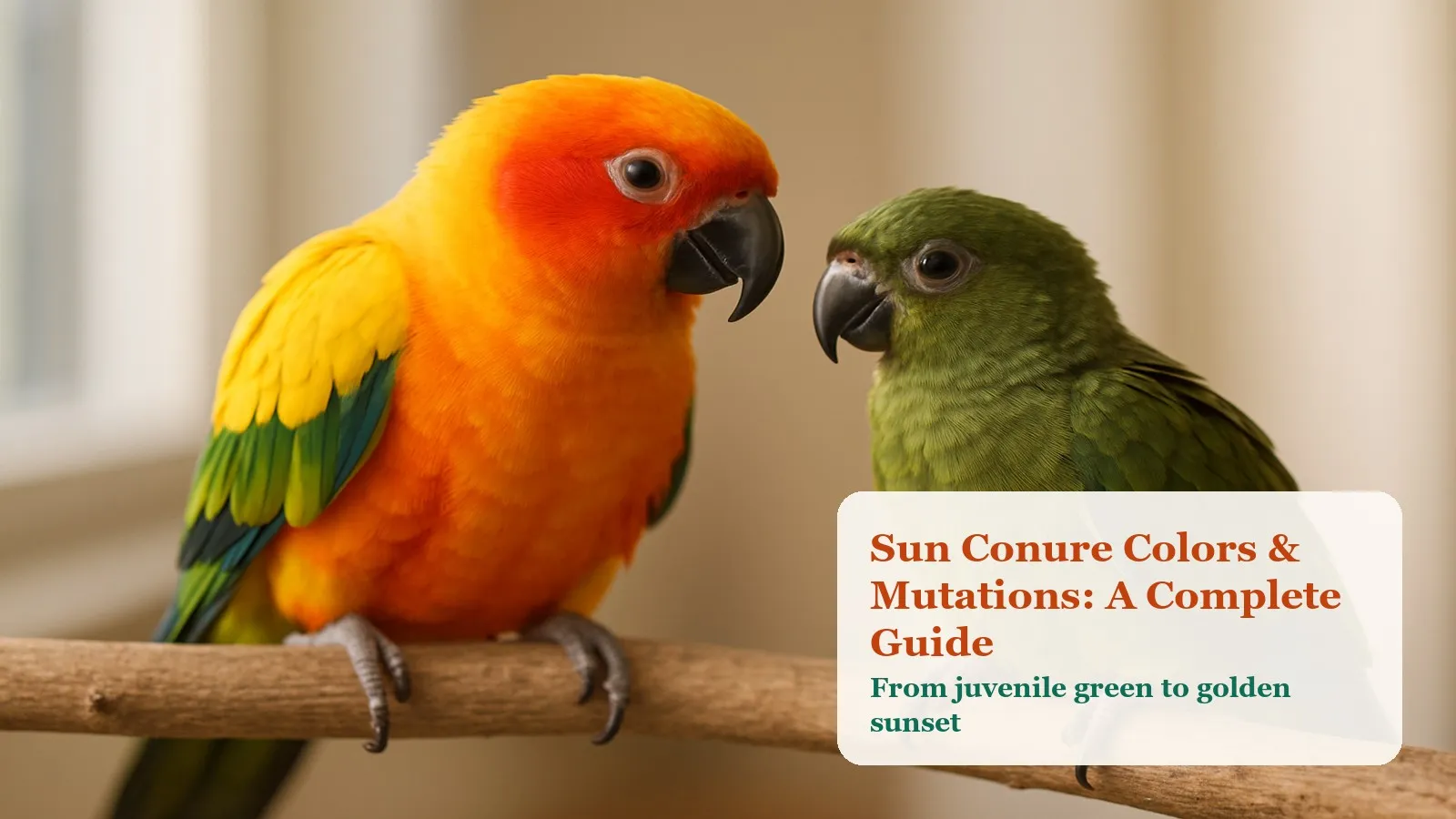
The sun conure is known for its blazing yellow, orange, and red plumage, but there is more to its color story than the adult “sunset” look. Young birds start out mostly green, and mutations can change the palette. Color can also tell you something about age and health. This guide covers normal sun conure coloring, how juveniles change, how color mutations work, and what to ask a breeder if you want something beyond the classic look.
What does a normal sun conure look like?
A normal (wild-type) adult sun conure, Aratinga solstitialis, has a distinctive pattern:
-
Head and belly: deep orange to reddish-orange, especially around the face, ear patches, and underside
-
Back and upper chest: bright golden yellow
-
Wings: yellow wing coverts, with green and blue flight feathers
-
Tail: olive-green with blue tips
-
Beak and feet: dark gray to black beak, gray feet
-
Eyes: dark, with a bare white-to-grayish eye ring
This is the color pattern most people picture. It is also the one you will see in the majority of sun conures for sale.
Why are baby sun conures green?
Sun conure chicks and juveniles are mostly olive-green, with yellow and orange showing up gradually. This surprises new owners who expected a golden bird. It is normal, and it is not a sign of a mutation or a health problem.
Color generally comes in over the first year or two through successive molts. The timeline varies from bird to bird.
| Age (approximate) | What you’ll typically see |
|---|---|
| Newly weaned chick | Mostly olive-green, some yellow on the face or chest |
| 6 months | Patches of yellow and orange appearing, especially on the head and body |
| 12 months | Much more yellow and orange, with some green remaining |
| 18-24 months | Full adult coloring in most birds |
If you want a bird that already shows lots of color, ask about age. If you want to watch the transformation, a young hand-raised bird is a rewarding way to do it.
How do bird color mutations work?
A mutation is a heritable change in how pigment is produced, deposited, or structured in the feathers. Breeders who keep and select birds showing these changes can establish them as color lines. How a mutation is passed on determines what you can expect from a pairing.
| Inheritance type | How it works | What it means for breeding |
|---|---|---|
| Autosomal recessive | A chick needs two copies of the gene, one from each parent, to show the color | Two “split” parents (carrying one copy) can produce visual mutation chicks |
| Sex-linked recessive | The gene sits on a sex chromosome; males need two copies, females only one | Results differ depending on whether the mutation is in the father or the mother |
| Dominant | One copy is enough to show the color | Visual birds can pass it on directly |
| Incomplete (co-)dominant | One copy gives one look, two copies give a stronger version | Single-copy and double-copy birds look different |
Two takeaways for buyers: a “split” bird looks normal but carries a hidden gene, and the only reliable way to know what a bird carries is the breeder’s records and pairing history.
What color mutations exist in sun conures?
Sun conures have far fewer established mutations than species like cockatiels, budgies, or ringnecks. The classic wild-type bird dominates the market. Mutations that have been reported or discussed in aviculture include:
-
Turquoise: a rarer variation with a noticeably different, often more muted look than the standard bird
-
Pallid / pastel-type (diluted) looks: softer, lighter versions of the usual color
-
Cinnamon-type effects: a warmer, brownish tone replacing some of the usual dark or gray areas
Names, appearance, and inheritance can vary between breeders and bloodlines, and the same look is sometimes marketed under different names. Treat any mutation name as a starting point, then ask for specifics before buying.
Because these birds are less common, availability changes, and a bird described as a mutation may simply be a normal bird in a transitional molt. Juvenile green is not a mutation.
Sun conure vs. look-alikes
People often confuse sun conures with other brightly colored parrots. A quick comparison helps:
| Bird | Main colors | Key differences |
|---|---|---|
| Sun conure | Yellow, orange, red-orange, green-blue wings | Orange covers face and belly, yellow back |
| Jenday conure | Yellow head, orange face, green body | Mostly green body, yellow only on the head and chest |
| Golden conure | Nearly all yellow with green wing tips | Larger, all-gold appearance |
| Green-cheeked conure | Mostly green with a gray chest and maroon tail | Smaller and much quieter, with muted color |
If you are comparing species rather than colors, our species guides go into size, noise, and temperament in more detail.
Can a sun conure’s color change or fade?
A healthy adult’s color should stay consistent from molt to molt. Several things can make a bird look duller or different:
-
Molting: feathers coming in can look patchy or short-lived in color
-
Diet: poor nutrition can affect feather quality and vibrancy. A varied diet with quality pellets plus fresh vegetables supports healthy feathering
-
Lighting: some bird-safe lighting and natural light affect how colors look to you, even if the feathers have not changed
-
Health: persistent dullness, stress bars, feather loss, or sudden color shifts are worth a call to an avian vet
Don’t assume a color change is cosmetic. When in doubt, have a bird checked by an avian veterinarian.
Does color affect personality or price?
Color does not determine temperament. A normal-colored, hand-raised sun conure and a rarer mutation bird will both be social, energetic, and vocal. Sun conures are known for loud contact calls, so plan for noise in either case.
Mutation birds are less common, which can affect price and availability. How a bird was raised, and how much handling it has had, matters more for companionship than its shade of yellow.
What to ask before buying a mutation sun conure
-
What is the bird’s exact mutation name, and how is it inherited?
-
Can you see the parents, or photos and records of them?
-
Is the bird a visual mutation, or a split carrying a hidden gene?
-
How old is the bird, and has it finished its first molt?
-
Is the bird DNA-sexed? (Sun conures look alike male and female)
-
Was it hand-raised and weaned, and has it had a vet check?
A reputable breeder will answer these without hesitation. If a seller is vague about genetics, move on.
Where to find a sun conure at Morphnests
Morphnests raises hand-fed parrots in Southern California and ships nationwide. You can see current availability on our sun conures for sale page. If you’re still weighing species, compare them with a jenday conure or browse our species guides. If you’re looking for a specific color, contact us and ask what’s available.
Frequently asked questions
What colors do sun conures come in?
The standard sun conure is golden yellow with orange to red-orange on the face and belly, and green and blue flight feathers. Rarer mutations exist, but the classic wild-type look is by far the most common.
Why is my baby sun conure green?
Juvenile sun conures are mostly olive-green and gain their yellow and orange through molts. Most reach full adult color somewhere between 12 and 24 months.
How old is a sun conure when it gets its full color?
Most sun conures show full adult plumage by about 1 to 2 years old, though timing varies between individual birds.
Are there sun conure color mutations?
Yes, but they are less common than in species like cockatiels or budgies. Turquoise and a few lighter or pastel-type variations have been discussed in aviculture. Ask breeders for documentation, since names and appearance can vary.
Can you tell if a sun conure is male or female by color?
No. Sun conures are monomorphic, meaning males and females look the same. DNA or surgical sexing is the reliable way to know.
Why is my sun conure losing its color?
Dull or patchy feathers can come from molting, diet, or lighting, but persistent color loss or feather damage can signal a health issue. Consult an avian vet if it continues.
Ready to bring home a Sun Conure? See our current Sun Conure for sale at Morphnests — hand-raised, DNA-sexed, and health-tested.