Senegal Parrot Behavior: Best 2026 Biting & Training Guide
Updated October 26, 2026
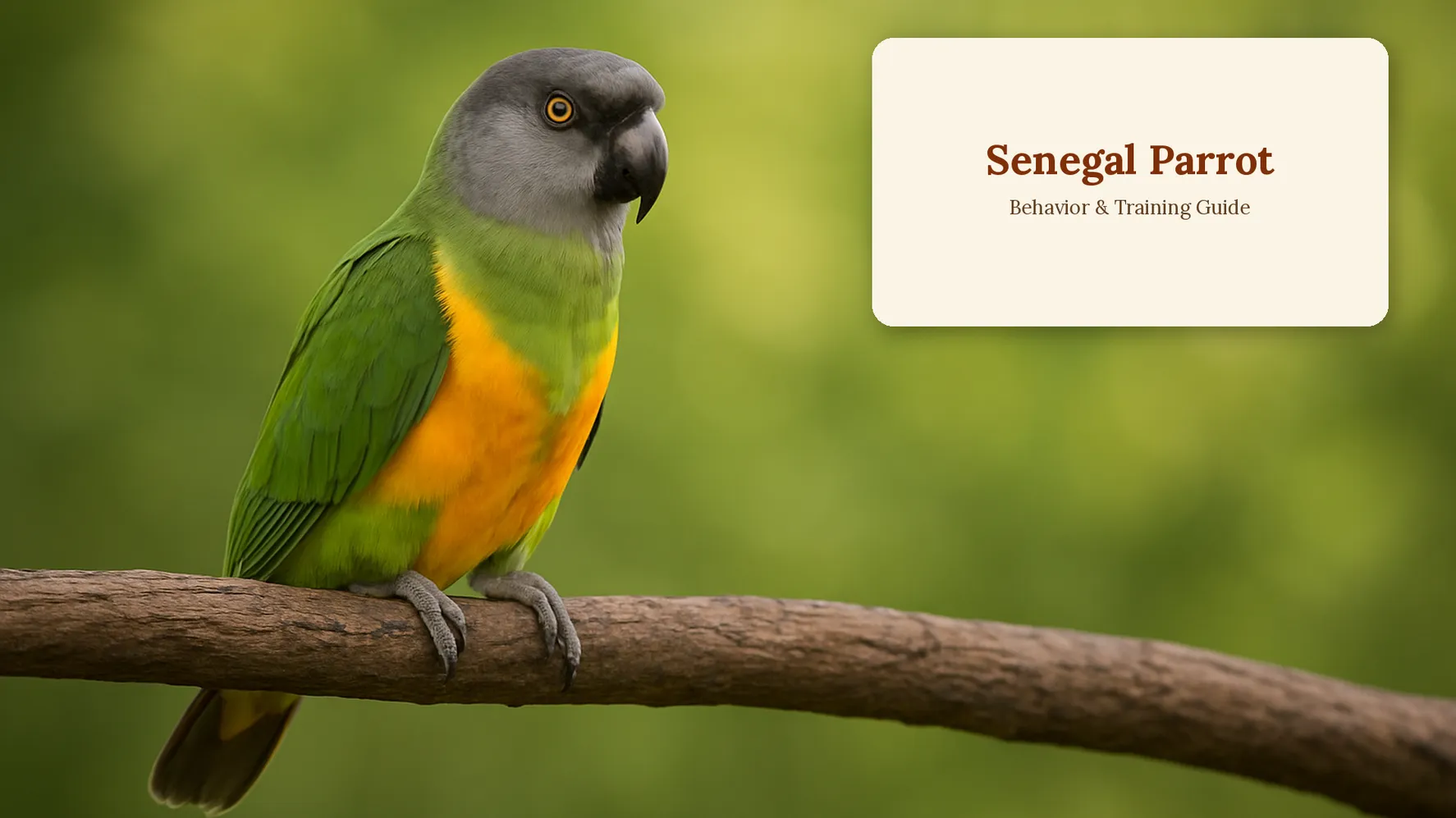
If you live with a Senegal parrot, you already know they are not shy about having opinions. Understanding Senegal parrot behavior is the single biggest factor in whether your relationship with this feisty little African parrot is a joy or a daily battle. Senegals are famous for bonding hard to one favorite person, for nipping first and asking questions later, and for going from calm to crouched-and-hissing in about two seconds flat.
Table of Contents
None of that means your bird is broken. It means Senegal parrot behavior follows its own logic, and once you can read it, most of the “problem” moments stop feeling random.
This guide breaks down why Senegal parrots bite, what the infamous “one-person bird” phase really means, how to read your bird’s body language before a bite happens, and the training approach that actually works on this species. If you are earlier in the process and still deciding whether a Senegal is the right fit, our complete Senegal Parrot guide covers care, cost, and personality basics first.
What Makes Senegal Parrot Behavior So Different?
Senegal parrots (Poicephalus senegalus) are a West African species, and like most Poicephalus parrots they pack a huge personality into a small, stocky body. A healthy adult is around 9 inches long and under 5 ounces, but Senegal parrot behavior rarely feels “small.” Owners often describe them as intense, opinionated, and quick to react compared to a mellower species of similar size.
Three traits drive most of what you will see day to day: a strong tendency to bond to one person, a low tolerance for being ignored or rushed, and a startle-then-bite reflex that is faster than almost any other common pet parrot. According to the Wikipedia entry on the species, Senegal parrots are native to the savanna and woodland of West Africa, where quick reactions to threats from above are a survival trait, not a character flaw.
In a living room, that same wiring shows up as flinching at sudden movement or biting when startled. Recognizing that this is instinct, not spite, is the first step to improving Senegal parrot behavior at home.
Why Do Senegal Parrots Bite? The Real Triggers
Biting is the number one Senegal parrot behavior question new owners search for, and the good news is that it is almost always explainable. A 2026 review of common case reports on Senegal biting points to a short, repeatable list of triggers rather than random aggression.
-
Fear or being startled — a hand moving too fast, a sudden noise, or being approached from behind.
-
Hormonal swings — mature Senegals, especially females, can go through hormonal phases that raise irritability and territorial biting, independent of a fixed “mating season.”
-
Jealousy and over-bonding — a bird that has picked one favorite person may bite anyone else who gets close, including a partner or child.
-
Pain or discomfort — sore feet from smooth dowel perches, an uncomfortable cage setup, or an undiagnosed health issue.
-
Boredom and under-stimulation — Senegals are active foragers and chewers in the wild, and a cage with nothing to shred or forage through quickly turns into frustration.
-
Inconsistent routine — irregular light schedules and unpredictable out-of-cage time can disrupt a bird’s sense of security.
Most problem Senegal parrot behavior traces back to one or more of these, not to the bird being “mean.” Fixing the environment usually does more than any single training session.
Reading the Warning Signs Before a Bite
Senegals give warnings, they are just quick ones. Watching for these cues lets you back off before a bite happens instead of after.
| Body Language | What It Usually Means | What To Do |
|---|---|---|
| Feathers fluffed up and still | Mild stress or uncertainty | Pause, speak softly, give space |
| Pupils rapidly dilating (“pinning”) | High arousal — excitement or agitation | Stop the interaction, do not push forward |
| Crouched body, raised wings | Defensive posture, bite likely | Withdraw your hand slowly, no sudden moves |
| Open beak, leaning away | Clear “stay back” signal | Respect it immediately |
| Relaxed feathers, soft eyes | Calm and approachable | Good time for handling or training |
The “One-Person Bird” Phase: Senegal Parrot Bonding Explained
Few things define Senegal parrot behavior as much as their tendency to pick a favorite person. Many Senegals bond intensely to one household member and become possessive, sometimes biting a spouse, roommate, or even the person who hand-raised them if someone else gets too close. This is not disloyalty on the owner’s part; it is simply how strongly this species attaches.
The phase is easier to manage than to eliminate entirely. Rotating who feeds, trains, and gives treats to the bird from a young age helps spread the bond across the household instead of locking it onto one person. If the behavior has already set in with an adult bird, the rest of the family can still build a relationship slowly, through calm, low-pressure sessions, rather than trying to force physical handling.
It also helps to remember that Senegal parrot behavior around jealousy is often situational. A bird that lunges at a partner while perched on your shoulder may be perfectly friendly with that same person across the room. Managing proximity, not just the relationship, solves a lot of these moments.
Senegal Parrot Training Tips That Actually Work
Punishment-based correction does not work on parrots, and it tends to make biting worse, not better. The training approach that reliably improves Senegal parrot behavior is positive reinforcement, paired with a stable routine.
-
Reset the light schedule. Keep the bird on a consistent 10-12 hour light and 10-12 hour dark cycle with a predictable cover time. Erratic lighting is a surprisingly common hidden stressor behind “random” biting.
-
Start clicker training. Pair a click with a small treat the instant your Senegal does something you want, like stepping onto a perch calmly. This builds trust through reward instead of fear.
-
Use “step up” consistently. Practice short, low-pressure step-up sessions daily so the cue stays reliable even outside training time.
-
Never punish a bite with yelling or flinching dramatically. Birds do not connect a scolding to the bite, and an excited reaction can accidentally reward the behavior as entertaining.
-
Withdraw calmly, then reset. If a bite happens, remove your hand without drama, pause, and try again once the bird’s body language looks relaxed.
-
Keep sessions short and end on success. Five to ten minutes of focused training beats a long session that wears the bird’s patience thin.
Consistency matters more than intensity. A Senegal that gets the same calm, predictable handling every day settles into good habits faster than one that gets occasional long sessions followed by days of being ignored — and that consistency is what ultimately shapes long-term Senegal parrot behavior more than any single technique.
Preventing Problem Senegal Parrot Behavior Before It Starts
A lot of biting and screaming can be headed off with a few environment changes rather than training alone.
-
Swap smooth dowel perches for rope or natural-wood perches of varying widths to keep feet comfortable.
-
Offer 5-10 toys, rotating a few out weekly so foraging and shredding stays novel.
-
Keep the food and water dishes at a comfortable height so the bird is not crouching to eat.
-
Give the cage a partial cover or placement against a wall so the bird does not feel exposed on all sides.
-
Feed a balanced base diet of pellets and fresh vegetables, saving seeds and nuts as occasional treats rather than the main meal.
-
Stick to a predictable daily routine for out-of-cage time, meals, and sleep.
None of these changes are complicated, but together they remove most of the background stress that turns into biting later — and a low-stress environment is the foundation that every other piece of good Senegal parrot behavior is built on.
When Senegal Parrot Behavior Needs Professional Help
Occasional nipping and a strong one-person preference are normal Senegal parrot behavior and respond well to the steps above. Persistent aggression, sudden behavior changes, feather plucking, or biting that draws blood regularly are different — those warrant a visit to an avian veterinarian to rule out pain, illness, or a hormonal issue that needs medical management rather than training alone. A vet can also confirm whether what looks like aggression is actually a bird that is unwell and defending itself.
Frequently Asked Questions About Senegal Parrot Behavior
Why is my Senegal parrot suddenly biting after being sweet for months?
A sudden shift usually points to hormones, a light-schedule disruption, pain, or a change in the home. Rule out health first, then review routine and environment.
Do all Senegal parrots become one-person birds?
Many do, but it is not universal, and early, shared handling across the household reduces how extreme the preference becomes.
How long does the hormonal biting phase last?
It varies by bird and is not tied to a strict yearly cycle. Some Senegals have brief irritable stretches; others cycle more often as adults.
Can Senegal parrot behavior problems be fixed in an older, previously neglected bird?
Yes, in most cases. It takes more patience than with a young bird, but consistent positive reinforcement and an improved environment both still work.
Senegal parrot behavior rewards owners who treat it as communication rather than defiance. A bird that bites, lunges, or picks a favorite person is telling you something specific about its comfort, its hormones, or its environment — and once you know what to look for, most of it is manageable. If you are ready to bring home a hand-raised Senegal of your own, see our current Senegal parrots for sale for availability and pricing.