Military Macaw: The Complete Guide to Size, Temperament, Care & Lifespan
Updated October 19, 2026
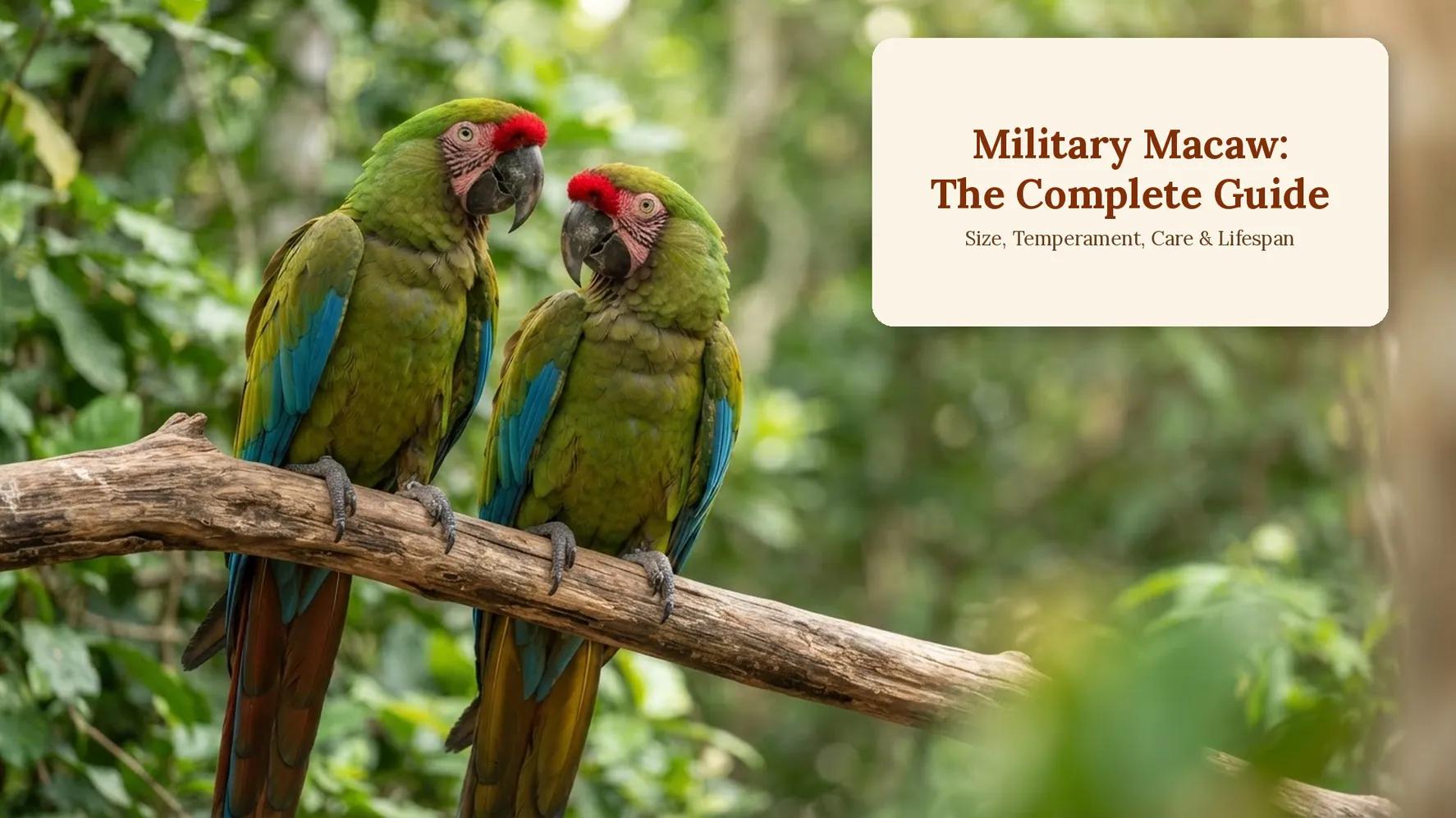
Military Macaws are medium-large, intelligent macaws known for cautious loyalty, loud voices, and a 50- to 60-year lifespan — not a beginner bird, but an excellent fit for an experienced owner with the space and time for one. This guide covers size, temperament, talking ability, noise, care requirements, and where to buy a healthy, legally sourced Military Macaw in the US.
What Is a Military Macaw?
This medium-large macaw (Ara militaris) is native to the mountain and cloud forests of Mexico, Central America, and parts of South America, where it’s classified as Vulnerable in the wild. In the US pet trade, it’s one of the more affordable large macaws — a step down in price from a Blue and Gold or Scarlet Macaw, but with the same long-term commitment.
It gets its name from its coloring, which resembles a military uniform: olive-to-forest green feathers with a bright red forehead patch, much like an officer’s insignia.
Size and Appearance
-
Length: 27 to 33 inches, nose to tail tip (the tail makes up roughly half of that)
-
Weight: 900 to 1,100 grams (about 2 to 2.4 lbs)
-
Wingspan: 33 to 43 inches
-
Coloring: Olive-green body, bright red forehead patch, blue flight feathers, and a tail that’s reddish-brown at the base, blue at the tip, and yellow underneath
-
Eyes and face: Pale yellow eyes with bare white-to-pinkish facial skin (unfeathered, like other large macaws) in adults
-
Feet and legs: Dark grey
They’re often confused with the smaller Severe Macaw or the similarly colored Buffon’s (Great Green) Macaw — size and the sharper red forehead patch are the easiest ways to tell them apart.
Military Macaw Temperament and Personality
They’re more reserved than their flashier macaw cousins. They’re cautious with new people and take time to warm up, but once they trust you, they bond hard — usually to one primary person. That one-person bonding is the biggest thing to plan around: a bird like this can become possessive or nippy toward other household members, especially during hormonal periods between ages 3 and 5.
With consistent, patient handling they’re highly trainable and food-motivated, which makes trick training and talking easier than with some other large macaws.
Are Military Macaws Good Talkers?
Yes. Most learn 20 to 100+ words and phrases, and some individuals pick up 150 or more. They tend to have clear, less raspy voices than Blue and Gold or Scarlet Macaws, which makes their speech easier to understand.
Are Military Macaws Loud?
Very. Expect long, loud calling sessions at dawn and dusk — a normal part of macaw behavior, not a training problem you can fully eliminate. This isn’t a realistic choice for an apartment, a condo with shared walls, or close neighbors who won’t tolerate occasional screaming.
Military Macaw Care Requirements
They’re rated an Expert-level bird, with care demands that match any large macaw.
Cage: Minimum 48×36×60 inches, heavy-gauge non-galvanized steel, bar spacing of 1 to 1.5 inches. Bigger is always better — this is a minimum, not a goal.
Diet: Roughly 60–70% high-quality macaw pellets, 25–30% fresh vegetables offered twice daily, and 5–10% fruit. Nuts are fine as occasional treats (a few per day, not a staple), and seeds should stay minimal. Avocado, chocolate, caffeine, and alcohol are toxic and must be avoided entirely.
Out-of-cage time: 3 to 4+ hours daily, supervised, in a bird-proofed space. This isn’t optional — a bird confined to its cage will become destructive, loud, or both.
Environment: 10 to 12 hours of full-spectrum or natural UV lighting, 65–80°F, 40–60% humidity.
Monthly cost once settled: Roughly $130 to $250 for food, toys, and routine supplies, not counting emergency vet care. Toys alone can run $50 to $100+ a month — they destroy wood and rope toys quickly and need a steady supply.
Households with young children: Generally not recommended for homes with kids under about 12–14, given the bite strength and tendency toward one-person bonding.
How Long Do Military Macaws Live?
50 to 60 years in captivity is typical, with well-cared-for birds sometimes living longer. That’s a multi-decade commitment, often outlasting the original owner — worth planning for in a will or estate arrangement, the way owners of other long-lived parrots do.
Military Macaw vs Other Macaws
| Species | Size | Price Range | Talking | Noise |
|---|---|---|---|---|
| Military Macaw | 27–33 in | $2,500–$4,500 | 20–100+ words | Very loud |
| Blue and Gold Macaw | 30–34 in | $2,749+ | 30–60 words | Very loud |
| Hahn’s Macaw (mini) | 12 in | $1,500–$2,500 | 10–20 words | Moderate |
| Scarlet Macaw | 32–36 in | $3,500–$6,000 | 20–40 words | Very loud |
Against the Blue and Gold Macaw specifically, this species tends to run a few hundred dollars cheaper, is a touch smaller, and is generally considered the more reserved, one-person bird of the two — see our Blue and Gold Macaw guide for a full side-by-side.
Is a Military Macaw Right for You?
This is a good fit if you have prior parrot experience, a home where a loud, large bird’s noise won’t be a problem, several hours a day for interaction, and are ready for a 50+ year commitment. It’s a tougher fit if this would be your first parrot, you live somewhere noise-sensitive, or you want a bird that bonds evenly with everyone in the household.
How Much Does a Military Macaw Cost?
Hand-raised, DNA-sexed babies from US breeders typically run $2,500 to $4,500, with first-year costs (cage, supplies, vet care) adding another $2,000 to $4,000 on top. For the full breakdown by age, subspecies, and what to budget month to month, see our complete Military Macaw price guide.
Where to Buy a Military Macaw the Right Way
This species is CITES Appendix I listed, so buying from a reputable US breeder — not importing or buying unweaned chicks from an unverified source — is the safe, legal route.
Watch for these warning signs of an underpriced or risky bird:
-
Prices around $800–$1,200 (well below the normal $2,500–$4,500 range)
-
Refusal to do a live video call with the bird
-
Stolen or stock photos instead of real, current pictures
-
Pressure to pay by irreversible methods (wire, crypto, gift cards)
-
Vague location, or unwillingness to share hatch/DNA records
-
Unweaned chicks sold directly to first-time owners
A legitimate breeder will provide DNA sexing documentation, health screening records (PBFD, polyoma, chlamydia), and hand-feeding history, and will welcome questions. See our full Military Macaw listing, browse all macaws for sale, or check our shipping policy for nationwide delivery details.
Frequently Asked Questions
Is a Military Macaw a good pet?
For an experienced owner with space, time, and tolerance for noise, yes. It’s not a good fit for first-time bird owners or noise-sensitive homes.
How big do Military Macaws get?
27 to 33 inches long with a 33 to 43 inch wingspan, weighing 900 to 1,100 grams.
Are Military Macaws rare?
Not in the US pet trade — it’s a commonly bred, readily available large macaw. In the wild, the species is classified as Vulnerable due to habitat loss.
Do Military Macaws bite?
They can, particularly during hormonal periods (roughly ages 3–5) or if mishandled. Consistent, positive training reduces this significantly.
How much does a Military Macaw cost?
$2,500 to $4,500 for a hand-raised, DNA-sexed baby from a US breeder. See our full price guide for a breakdown by age and first-year costs.
Do Military Macaws need a permit in the United States?
No federal pet permit is required for domestic ownership, though the species is CITES Appendix I listed, which affects international import/export, not buying from a US breeder.
What’s the difference between a Military Macaw and a Blue and Gold Macaw?
It’s slightly smaller, typically a few hundred dollars cheaper, and tends to be more reserved and one-person-bonded. The Blue and Gold Macaw is slightly larger and often considered a bit more outgoing. See our Blue and Gold Macaw guide for a full comparison.