Golden Conure Price: Best 2026 Gold Cap Guide
Updated October 30, 2026
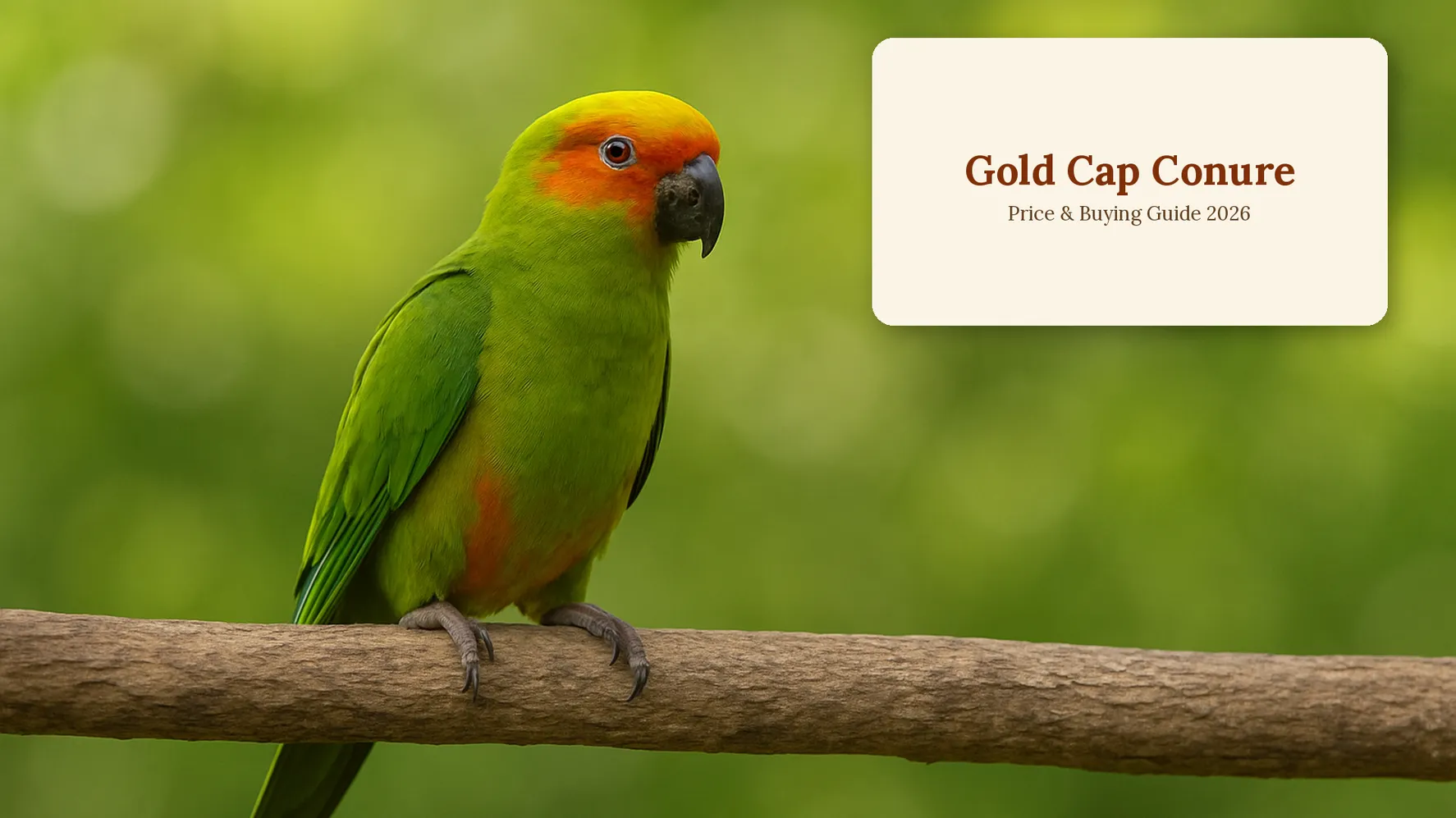
If you’ve been searching for the real golden conure price, you’ve probably noticed the numbers online are all over the map. That’s partly because “golden conure” gets used loosely for a few different birds, and partly because golden conure cost depends on more than just the species. This guide breaks down exactly what a Gold Cap Conure actually is, what a fair golden conure price looks like in 2026, and how to buy one the right way.
Table of Contents
Golden Conure Price: What You’ll Pay for a Gold Cap Conure in 2026
A healthy, hand-raised Gold Cap Conure from a reputable breeder typically runs somewhere between $500 and $900, with most buyers landing in the $600-$700 range once DNA sexing and a health screening are added in. That golden conure cost reflects a bird that’s been properly weaned, handled daily, and tested for common diseases before it ever goes home with you.
Birds priced well under $400 are worth a second look. A low golden conure price can mean an unweaned chick being sold too early, a bird from an unscreened breeding pair, or a mislabeled Sun Conure or Jenday Conure being passed off under the more eye-catching “golden conure” name. More on that mix-up below, because it matters for your wallet as much as for the bird’s health.
What Is a Gold Cap Conure?
The Gold Cap Conure (scientifically Aratinga auricapillus), also called the Golden-Capped Conure or Golden-Capped Parakeet, is a small-to-medium conure native to the dry savannas and lowland forests of eastern Brazil. Adults run about 11-14 inches long and weigh roughly 5 ounces, putting them squarely in the same size class as a Sun Conure or Jenday Conure.
Markings are what make this bird unmistakable once you know what to look for. The body is a vivid green from the back through the wings and tail, with no blue feathers anywhere. The forehead and the skin around the eyes are a fiery orange-red, fading upward into the bright yellow-gold crown that gives the bird its name — the “gold cap.”
A reddish-orange patch runs across the lower belly and the edges of the rump. The beak is solid black, and a thin grey eye-ring sets off a pale yellow eye in adults (juveniles show a browner eye and duller head markings until they mature).
Males and females are visually identical, so the only reliable way to confirm sex is DNA testing — something every golden conure price quote from Morphnests already includes as an add-on option.
What Drives Golden Conure Cost Up or Down
Four things move the needle on golden conure cost more than anything else:
-
Hand-feeding and weaning quality. A chick that’s been hand-fed and allowed to fully wean on its own schedule costs more to raise, and it shows in temperament for years afterward.
-
Health screening. A disease panel and vet check add to the upfront golden conure price, but they protect you from inheriting an expensive problem.
-
DNA sexing. Since Gold Cap Conures can’t be sexed by sight, confirmed-sex birds (especially confirmed females for anyone planning to breed) often carry a modest premium.
-
Breeder reputation and demand. Because wild Gold-Capped Conure populations are considered Near Threatened, captive-bred birds from established aviaries are in steadier demand than less common imports or rescues.
Add-ons like a starter kit (cage, toys, initial food) push the total further but save you a scramble the week you bring your bird home.
Gold Cap Conure vs. Sun Conure: Don’t Confuse the Two
This is the single biggest source of confusion in golden conure price searches, and it’s worth clearing up before you buy. The Sun Conure (Aratinga solstitialis) is mostly bright yellow and orange with green-tipped wings, while the true Gold Cap Conure is mostly green with a red-and-gold head and a patch of orange on the belly — not the other way around.
Sellers sometimes use “golden conure” loosely for either bird, so always confirm the species name and ask to see current photos before paying.
If you’re set on the sunshine-yellow look, our Sun Conure for Sale guide covers that bird specifically. If the green-bodied, gold-capped look above is what you want, you’re in the right place.
Temperament and Personality
Gold Cap Conures are energetic, social, and genuinely affectionate once bonded. They like to swing, chew, and climb, and a well-socialized bird will often perch on a shoulder or snuggle up during downtime. They’re rated as fair talkers — expect a handful of words and sounds rather than a large vocabulary.
The flip side of that energy is volume. Left without enough attention or mental stimulation, this conure can become nippy and will scream to get noticed. Daily interaction and a steady rotation of chewable toys keep that behavior in check, and it’s a realistic trade-off to weigh before any golden conure cost decision — this isn’t a quiet apartment bird for someone who’s rarely home.
Diet and Daily Care
A quality pellet blended with fresh fruits and vegetables should make up the bulk of the diet, with seeds offered only in moderation since they’re high in fat. Leafy greens, berries, apple, and cooked sweet potato are all good regular additions. Avocado and chocolate are toxic to parrots and should never be offered.
Fresh water, daily out-of-cage time, and regular bathing or misting round out the basics. Like most conures, Gold Caps appreciate routine — feeding and interaction at consistent times each day go a long way toward a stable, well-adjusted bird. None of this ongoing care shows up in the sticker-price golden conure price you see when you first shop, so budget for food and enrichment as part of the real cost of ownership.
Housing and Cage Size
Bigger is always better with this species. For an indoor home, aim for a cage at least 24 x 24 x 36 inches with horizontal bar spacing the bird can climb. Fill it with varied perches and chew-safe wood toys to burn off that characteristic conure energy. An outdoor or aviary setup should include a deep nest box, since this species readily breeds in captivity once mature.
Gold Cap Conures do well in typical household temperatures between about 65°F and 80°F, though they can tolerate a somewhat wider range once acclimated. Keep the cage away from drafts, direct AC vents, and the kitchen, where nonstick cookware fumes and aerosols pose a real risk to any parrot’s respiratory system. A larger cage adds to the overall golden conure price of getting set up, but it pays off in a calmer, less bored bird.
Lifespan and Health
With good care, a Gold Cap Conure can live 20 to 30 years, which is a serious long-term commitment to factor in alongside the initial golden conure price. Routine vet checkups, a varied diet, and plenty of activity are the biggest levers you have over that lifespan. A pre-purchase disease panel is the best first step toward a healthy multi-decade relationship with your bird.
How to Buy a Gold Cap Conure the Right Way
-
Confirm the species. Ask for clear, current photos and verify the green body, red-and-gold head, and orange belly patch described above — not the yellow-orange look of a Sun Conure.
-
Ask about hand-feeding history. A fully weaned, hand-raised chick settles into a new home far more easily than one pulled too early.
-
Request DNA sexing. Confirm whether sexing is included in the golden conure cost or offered as an add-on.
-
Ask for health documentation. A disease panel and a clean bill of health from the breeder’s vet should come standard, not as an afterthought.
-
Plan your setup before pickup. Have the cage, perches, and starter food ready so the bird isn’t waiting on you to get settled.
-
Confirm shipping or local pickup. Reputable breeders ship nationwide via professional pet cargo with proper health paperwork — ask how the bird will travel if you’re not local.
-
Compare the full golden conure price, not just the headline number. Add DNA sexing, health screening, and any starter kit into your total before comparing breeders.
Gold Cap Conure at a Glance
| Trait | Details |
|---|---|
| Scientific name | Aratinga auricapillus |
| Size | 11-14 inches, ~5 oz |
| Typical golden conure price | $500-$900 (hand-raised, DNA-sexed) |
| Lifespan | 20-30 years |
| Noise level | Loud; can scream if under-stimulated |
| Talking ability | Fair |
| Minimum cage size | 24 x 24 x 36 inches |
| Conservation status | Near Threatened in the wild |
Golden Conure Price FAQ
Is “golden conure” the same bird as a Gold Cap Conure?
Usually, yes — “golden conure” and “Gold Cap Conure” refer to the same species, Aratinga auricapillus. Just be careful it isn’t being used as a stand-in for the similarly colorful but visually different Sun Conure.
Why is golden conure cost higher than some other conures?
Golden conure cost reflects hand-feeding, DNA sexing, and health screening, plus the fact that this species is considered Near Threatened in the wild, which keeps well-bred captive stock in steady demand.
Are Gold Cap Conures good for first-time bird owners?
They can be, provided the owner is ready for a loud, high-energy bird that needs daily attention. Anyone wanting a quieter first bird may want to compare notes with a calmer species before committing.
How long does a Gold Cap Conure live?
Expect 20 to 30 years with good nutrition, an appropriately sized cage, and regular veterinary care — plan the golden conure price as the first of many years of costs, not a one-time purchase.
Do male and female Gold Cap Conures look different?
No. The sexes are visually identical, so DNA testing is the only reliable way to confirm whether your bird is male or female.