Cockatiel Colors and Mutations: Complete Visual Guide to All 14 Types
Updated November 7, 2026
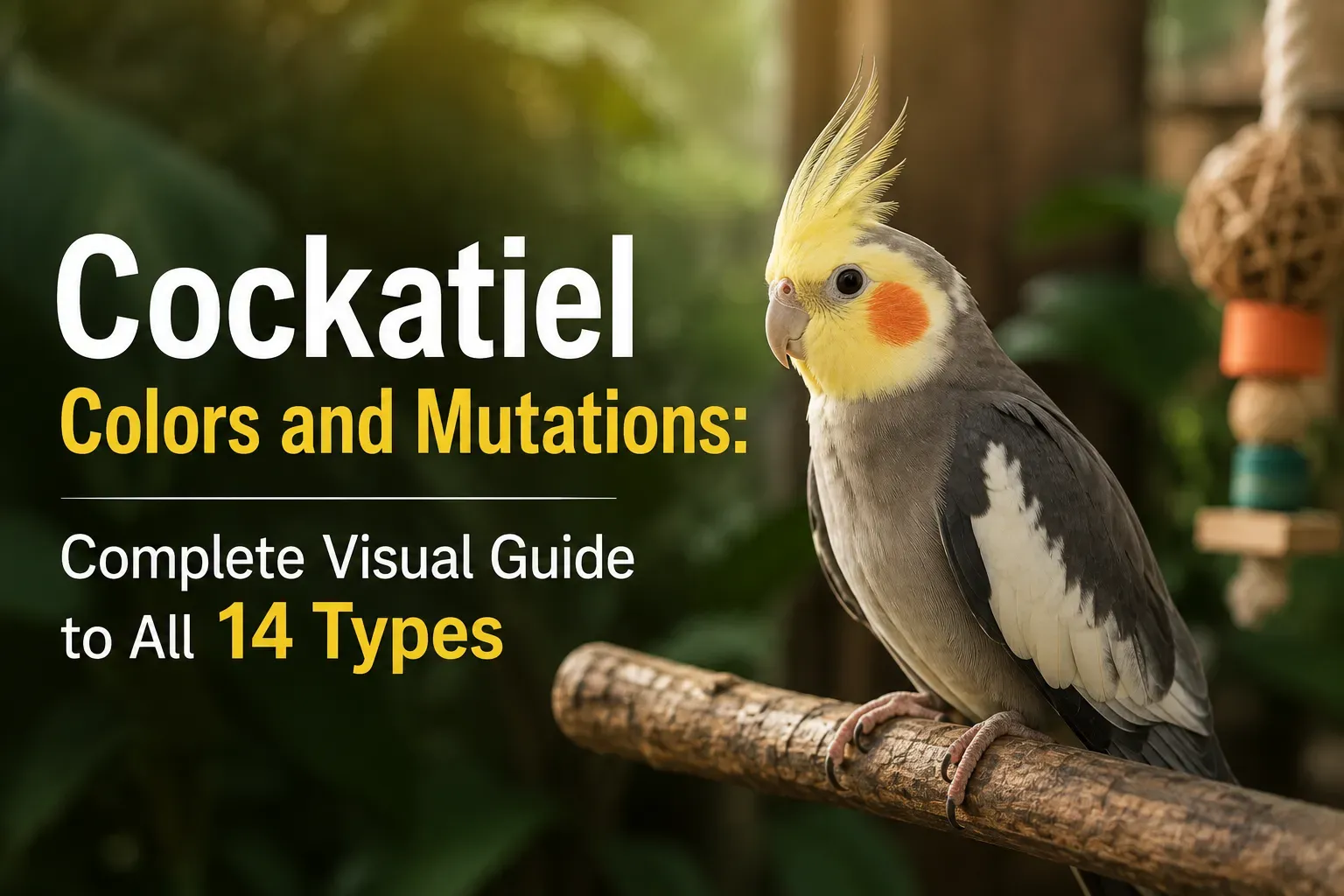
The Cockatiel is one of the most popular pet parrots in the world, and selective breeding over the past 60 years has produced an astonishing range of colour mutations. Some cockatiel colours look so different from the wild type that they are hard to believe they are the same species. This guide walks through all 14 main cockatiel colour mutations, what they look like, what they cost, and how to identify each one.
How to tell similar cockatiel colors apart
Look for the pattern as well as the base color. Pearl has repeated scalloping, while pied has irregular light patches. Lutino usually retains orange cheek patches, while whiteface lacks orange cheek patches. A whiteface lutino combines the whiteface appearance with red eyes. Ask for a current photo and the breeder’s identification, then check the cockatiel listings for prices and availability.
What is a Cockatiel colour mutation?
A colour mutation is a genetic variation that changes the pigmentation of a bird’s feathers, skin, or eyes. All cockatiel colour mutations are Nymphicus hollandicus, the same species as the wild type Normal Grey Cockatiel. They differ only in pigment expression. Personality, size, noise level, care requirements, and lifespan (15 to 25 years) are identical across all mutations.
The 7 primary cockatiel mutations
1. Normal Grey (Wild Type)
The classic look. Grey body, white wing bars, bright orange cheek patches, and a yellow head (in males) or a duller grey head with softer cheek patches (in females). This is the appearance the species has in the wild across Australia.
2. Lutino
The most popular mutation after Normal Grey. All yellow to white body with orange cheek patches and red eyes. First established in the 1950s. Males and females are visually similar in Lutino, making them slightly harder to sex without DNA testing.
3. Pied
Random patches of yellow or white replace parts of the grey base. No two Pieds look exactly alike. Pieds can be heavily marked (mostly yellow with grey patches) or lightly marked (mostly grey with small yellow patches).
4. Pearl
A distinctive spotted or scalloped pattern on the wings and back. Pearl mutation is sex linked, meaning males lose most of their pearling after their first molt while females retain it for life. If you want a permanent pearl pattern, choose a female Pearl.
5. Cinnamon
The grey base is replaced with a soft warm brown grey. Cheek patches remain orange. Cinnamons look almost pastel compared to Normals.
6. Whiteface
Removes all yellow and orange pigment from the bird. A Whiteface Normal looks like a black and white bird with grey body, white face (males) or grey face (females), and no cheek patches. First established in the 1980s.
7. Albino (Whiteface Lutino)
A combined mutation. All white body, red eyes, no orange or yellow anywhere. Technically not a true albino (a real albino has no melanin at all) but the common name is standard in the pet trade.
Combined mutations you may encounter
Because cockatiel mutations are inherited independently, breeders can combine two or more mutations in a single bird. Some of the most common combined mutations:
-
Cinnamon Pearl: soft warm brown base with pearl scalloping. $150.
-
Whiteface Pearl: no orange cheek patches, plus pearl scalloping on the wings. Striking. $150.
-
Cinnamon Pearl Pied: all three mutations in one bird. Complex and beautiful. $150.
-
Lutino Pied: yellow with white pied patches. Uncommon. $150.
-
Whiteface Cinnamon: warm brown body with no yellow or orange. $150.
-
Fallow: rare mutation with reduced melanin, giving a soft yellow brown appearance.
-
Silver: dilute grey base, appears powder blue in some lighting. Rare. $150.
Cockatiel colour mutation price table
| Colour Mutation | Appearance | Current pricing |
|---|---|---|
| Normal Grey | Grey with orange cheeks | Check listing |
| Lutino | Yellow with red eyes | Check listing |
| Pied | Grey with yellow patches | Check listing |
| Pearl | Grey with scalloped wings | Check listing |
| Cinnamon | Warm brown grey | Check listing |
| Whiteface | Grey and white, no orange | Check listing |
| Albino (Whiteface Lutino) | All white, red eyes | Check listing |
| Combined mutations | Two or more mutations | Check listing |
At Morphnests we hand raise several cockatiel colour mutations. To see currently available babies, visit our cockatiels category page or read our hand fed cockatiels in California guide for local buyers.
Sex linked cockatiel mutations
Four cockatiel mutations are sex linked, meaning they are inherited on the X chromosome. This has practical implications:
-
Lutino, Pearl, Cinnamon, and Silver are all sex linked mutations
-
Female cockatiels carrying a sex linked mutation always express it visually
-
Male cockatiels carrying a sex linked mutation only express it if they carry two copies
-
Male Pearls lose their pearling after their first molt at 6 to 9 months. Females retain it for life.
If you specifically want a Pearl pattern that stays for the bird’s whole life, ask the breeder for a female bird.
Do colour mutations affect personality or care?
No. All cockatiel colour mutations are the same species with identical personality, cage requirements, diet needs, noise levels, and lifespan. Choose the colour you love; personality is consistent. All cockatiels are among the most affectionate and beginner friendly parrots you can own. See our easiest parrots for beginners guide for the full picture of why cockatiels rank number one for first time bird owners.
How to identify a cockatiel colour mutation
Quick identification checks:
-
Look at the eyes. Red eyes mean Lutino or Albino. Dark eyes mean Normal, Pied, Pearl, Cinnamon, or Whiteface.
-
Look at the cheek patches. Orange means the yellow pigment gene is present (Normal, Lutino, Pied, Pearl, Cinnamon). No orange means Whiteface or Albino.
-
Look at the base colour. Grey means Normal. Warm brown means Cinnamon. Yellow to white means Lutino. Pure white means Albino.
-
Look at the wing pattern. Scalloped or dotted means Pearl. Patches of colour means Pied. Solid means Normal.
Where to buy a cockatiel
Cockatiels are one of the most widely bred pet parrots, and finding a specific colour mutation is usually straightforward from a specialty breeder. At Morphnests we hand feed cockatiels from around 3 weeks of age. To see currently available babies, visit our cockatiels category page, the new born babies page, or contact Mo directly for photos of any specific colour mutation.
Frequently asked questions
What is the rarest cockatiel colour?
Fallow, Silver, and rare triple combined mutations (like Whiteface Cinnamon Pearl Pied) are the rarest and most expensive cockatiel colour mutations.
Which cockatiel mutation is the friendliest?
Personality is identical across all mutations. All cockatiels are among the most affectionate small parrots when hand raised, regardless of colour.
Do Lutino cockatiels have health problems?
Lutino cockatiels have historically been associated with a bald spot behind the crest due to selective breeding for the mutation. Modern well bred Lutinos from established breeders show much less of this issue than older lines.
Are Whiteface cockatiels more expensive?
Yes, moderately. Whiteface is a less common mutation than Normal or Lutino, so hand raised Whiteface cockatiels typically run 30 to 60 percent higher than Normals.
How do you tell a male cockatiel from a female?
In Normal Grey adults, males have bright yellow heads with vivid orange cheek patches, and females have grey heads with duller cheek patches. In many mutations (especially Lutino), visual sexing is unreliable and DNA sexing is recommended.