Alexandrine Parakeet For Sale: Best 2026 Buying Guide
Updated October 26, 2026
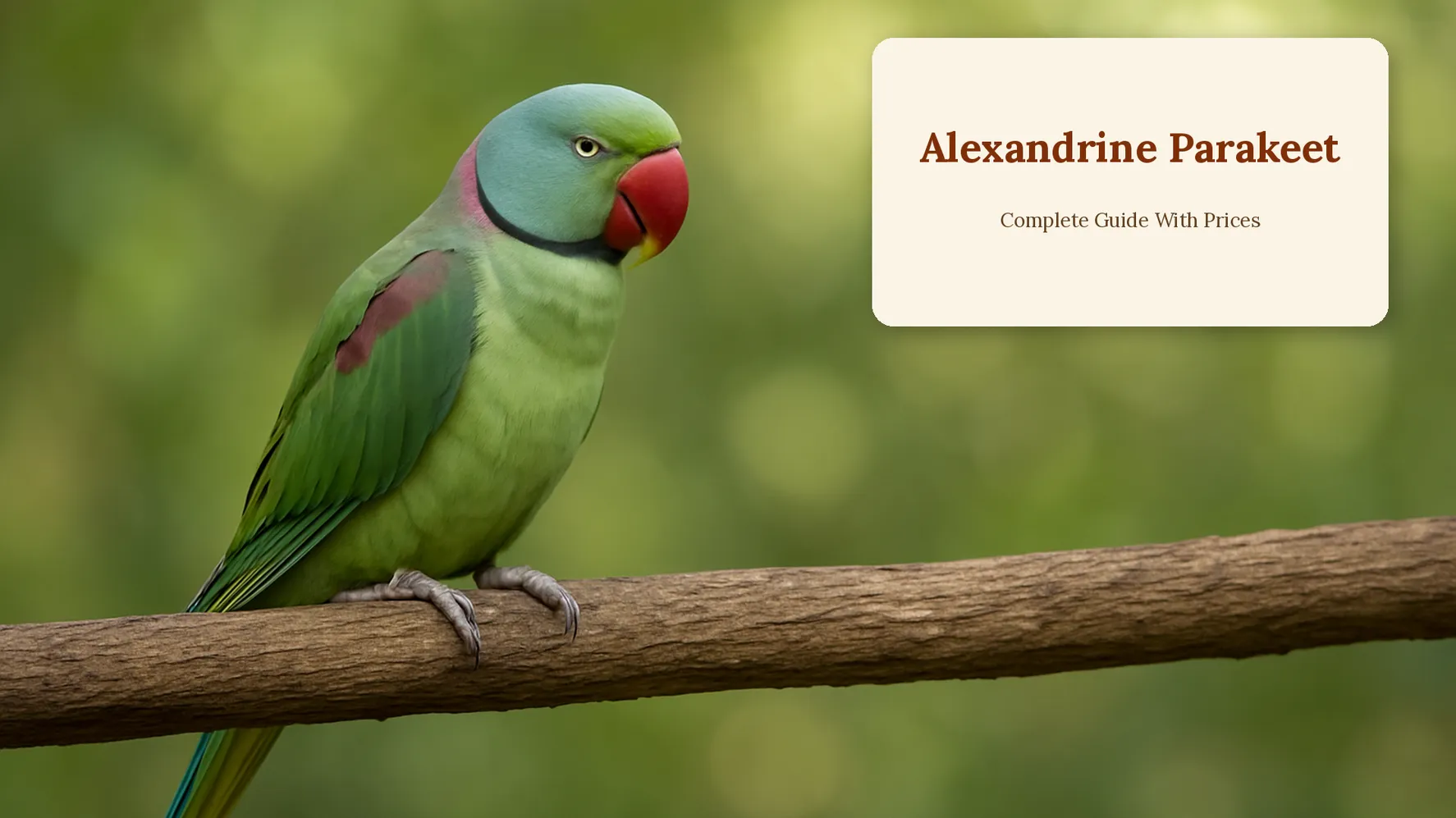
If you have fallen for the deep red beak and maroon shoulder patch of this species, you are probably already searching for an Alexandrine parakeet for sale and wondering what separates a healthy, well-socialized bird from a risky impulse buy. This guide walks through size, lifespan, temperament, and real pricing so you know what you are getting before you bring one home.
Table of Contents
We will also cover how an Alexandrine parakeet compares to its smaller cousin the Indian Ringneck, what daily care actually looks like, and the questions buyers ask most often when they shop for an Alexandrine parakeet for sale online.
What Is an Alexandrine Parakeet?
The Alexandrine parakeet (Psittacula eupatria) is one of the largest parakeets in the world, native to the forests and agricultural lowlands of South and Southeast Asia. The species is named for Alexander the Great, who is said to have kept one as a pet and helped introduce it to Europe.
In the wild, flocks forage on seeds, buds, fruit, and nuts, and the bird’s intelligence and talking ability have made it a long-standing favorite among parrot keepers who want a bigger, calmer alternative to the Indian Ringneck. Anyone browsing an Alexandrine parakeet for sale listing for the first time is often surprised by the bird’s size relative to a standard ringneck. This is a substantial parrot with a big personality, and it deserves a buyer who has done their homework.
Alexandrine Parakeet Size and Appearance
A mature Alexandrine parakeet measures roughly 22 to 24 inches from head to tail tip, making it noticeably larger and heavier-bodied than an Indian Ringneck. The plumage is a rich grass-green with a yellow-green wash on the belly, and a light blue-grey sheen covers the cheeks and back of the head.
The signature field mark is a maroon-red patch on each shoulder, present on both males and females, which is the easiest way to tell this species apart from a plain green ringneck at a glance. Males and females can be told apart once they mature: adult males develop a black stripe across the lower cheek that sweeps into a rose-pink band around the nape, while hens and juveniles lack both markings and keep a cleaner green head.
The massive red beak with a yellow tip is present in both sexes and is another unmistakable identifier of the species.
-
Length: approximately 22 to 24 inches nose to tail
-
Weaning weight: around 100 to 120 grams at 12 to 16 weeks, reaching 200 to 300 grams as a full adult
-
Beak: large, bright red with a yellow tip
-
Signature marking: maroon shoulder patch on both sexes; black cheek stripe and rose nape band on mature males only
Alexandrine Parakeet Lifespan and Health
With proper diet, veterinary care, and an appropriately sized enclosure, an Alexandrine parakeet can live 25 to 35 years, and some well-kept companion birds reach 40. That lifespan is a serious commitment, so anyone evaluating an Alexandrine parakeet for sale should think in decades, not years.
Reputable breeders disease-test and DNA-sex their birds before sale, and a short health guarantee at the time of purchase is a reasonable minimum to look for. Ask to see documentation of any testing before you commit to a deposit.
Alexandrine Parakeet For Sale: Price and What to Expect
Pricing on an Alexandrine parakeet for sale varies by breeder, region, and whether the bird is DNA-sexed or disease-tested, but buyers should budget well above what a standard Indian Ringneck costs given the larger size and longer rearing period. Hand-raised, captive-bred babies from a reputable aviary typically sell somewhere in the four-figure range, with optional add-ons that raise the final cost.
| Cost factor | What it covers |
|---|---|
| Base price | Hand-raised, weaned Alexandrine parakeet baby |
| DNA sexing | Lab-confirmed gender before the bird comes home |
| Disease panel | Testing for common avian pathogens prior to sale |
| Starter kit | Carrier, initial diet, and basic supplies |
| Shipping | Nationwide live-animal air cargo to your nearest airport |
Always confirm what is included before you commit. A price that looks unusually low for an Alexandrine parakeet for sale is a red flag worth asking about, since it may mean the bird is unweaned, untested, or not actually captive-bred.
Alexandrine Parakeet Temperament and Talking Ability
Alexandrines are known for a calmer, steadier temperament than Indian Ringnecks while matching or exceeding them in talking ability. A well-socialized bird can build a vocabulary of dozens of words and phrases, and many owners describe the species as having real “presence” in a room.
That said, Alexandrines can also be strong-willed and territorial, especially during hormonal periods, and they need a confident, consistent owner who sets boundaries early. Because of their size and the strength of that large red beak, this is not typically recommended as a first bird for a household with small children, though an experienced owner or a family willing to put in the training time will usually find the species rewarding.
Alexandrine vs. Indian Ringneck: What Is the Difference?
Buyers comparing an Alexandrine parakeet for sale against an Indian Ringneck often assume they are nearly the same bird with different names. They are closely related Psittacula species, but the differences matter for anyone choosing between them.
-
Size: Alexandrines run noticeably larger and heavier-bodied than ringnecks.
-
Shoulder patch: Alexandrines have the maroon shoulder patch on both sexes; ringnecks do not.
-
Temperament: Alexandrines tend to be calmer day to day, while ringnecks can be more nippy, especially as juveniles.
-
Lifespan: both species are long-lived, but Alexandrines often edge out ringnecks at the upper end, into the 30s and even 40s.
-
Price: Alexandrines generally cost more due to their size and longer rearing time.
If you are still deciding between the two, our Indian Ringneck Parrot Complete Guide covers colors, care, and cost for that species in detail.
Caring for an Alexandrine Parakeet at Home
Daily care for this species is similar to other large parakeets, but the bird’s size and intelligence raise the bar on space and enrichment.
-
Cage size: the World Parrot Trust recommends an enclosure at least 15 feet long for Alexandrines when possible, or the largest flight cage your space allows, with metal or welded-mesh construction strong enough to resist that powerful beak.
-
Diet: a balanced base of formulated pellets supplemented with fresh vegetables, leafy greens, limited fruit, and a controlled amount of nuts and seeds.
-
Enrichment: daily time out of the cage, foraging toys, and consistent training sessions to prevent boredom-driven feather plucking or screaming.
-
Social time: this is a flock bird by nature and needs real daily interaction, not just a cage in a quiet room.
-
Veterinary care: an annual wellness exam with an avian vet, plus prompt attention to any change in droppings, appetite, or feather condition.
Training works best with short, positive-reinforcement sessions, several times a day, rather than one long session. Target training and simple word repetition during those sessions also builds the bond that makes this species such confident talkers as adults.
Is an Alexandrine Parakeet For Sale Right for You?
Before you buy, be honest about the space, time, and multi-decade commitment this species requires. An Alexandrine parakeet for sale is the right fit if you can offer a large cage, daily out-of-cage time, and the patience to work through a strong-willed personality, especially in the first year.
It is probably not the right fit if you want a quiet apartment bird, have very young children who will handle the bird unsupervised, or are not prepared for a pet that may outlive you by decades.
Where to Find an Alexandrine Parakeet For Sale
When you search for an Alexandrine parakeet for sale, look for a breeder who hand-raises chicks, offers DNA sexing and disease testing, and can answer detailed questions about the parents’ history and the chick’s weaning process.
A breeder who ships nationwide via professional live-animal cargo, rather than unregulated courier services, is a strong signal that the operation takes bird welfare seriously. According to the Wikipedia entry on the Alexandrine parakeet, the species is native to South and Southeast Asia and has also established sizable feral populations across parts of the Middle East and Europe, a testament to how adaptable and hardy these birds are when properly cared for.
Morphnests hand-raises and DNA-tests its Alexandrine parakeets in Southern California before they ship nationwide. You can see current availability and pricing on our Alexandrine parakeet for sale page.
Frequently Asked Questions
How much does an Alexandrine parakeet for sale cost?
Pricing for a hand-raised, captive-bred Alexandrine parakeet for sale typically runs in the four-figure range before optional add-ons like DNA sexing, disease testing, and a starter kit.
How big do Alexandrine parakeets get?
Adults reach roughly 22 to 24 inches from head to tail, making them one of the larger parakeet species kept as companion birds.
Are Alexandrine parakeets good talkers?
Yes. A well-socialized Alexandrine parakeet can learn dozens of words and phrases and is considered one of the better-talking parakeet species.
How long do Alexandrine parakeets live?
With good care, 25 to 35 years is typical, and some individuals live into their 40s.
Is an Alexandrine parakeet a good first bird?
They can be, for an owner willing to commit to training and a large enclosure, but their size and strong beak make them better suited to someone with some prior bird-handling experience.